Case Study
Dr Assistant (AI-HP)
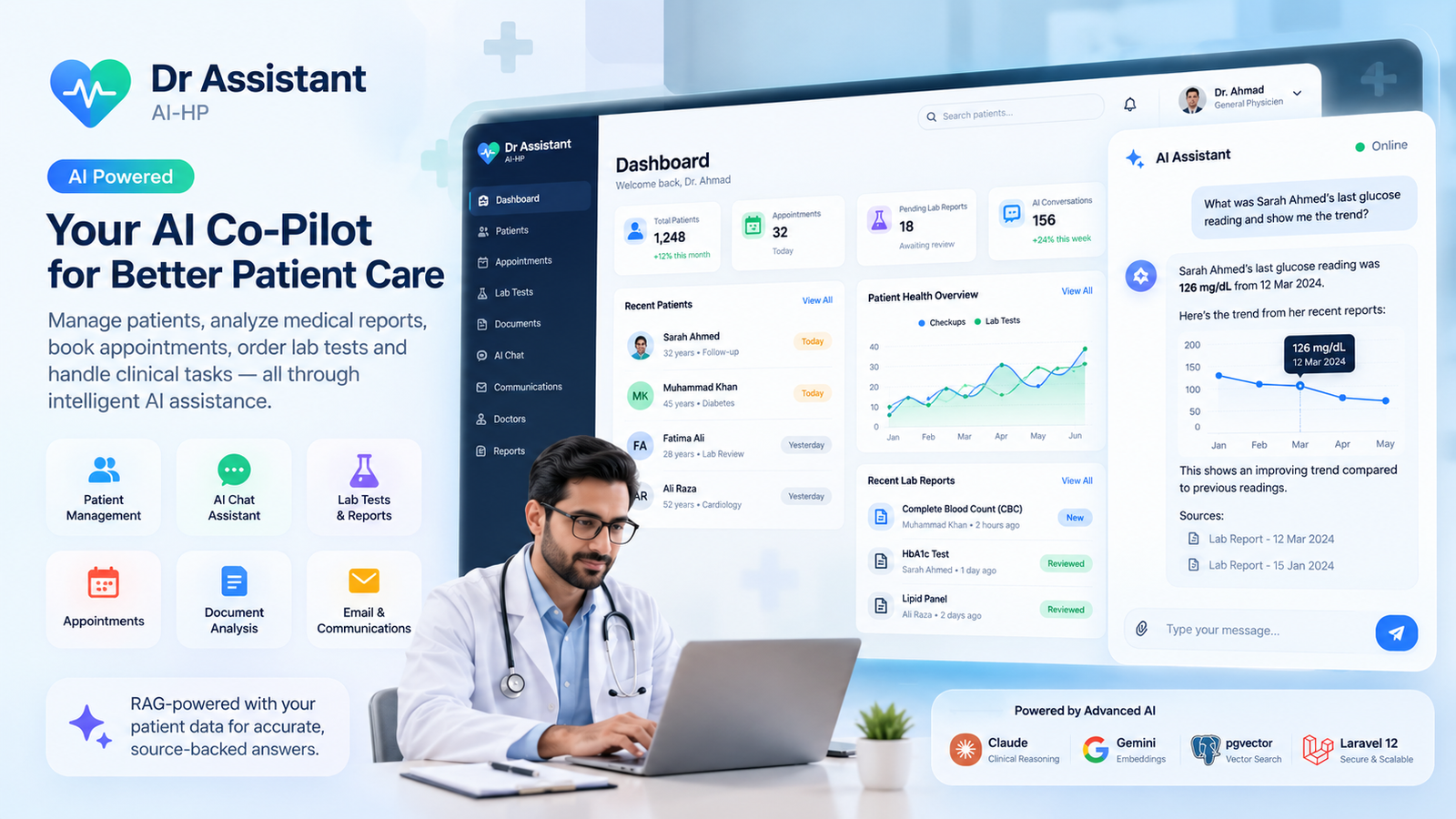
Dr Assistant (AI-HP) is an AI-powered clinical management platform and conversational medical co-pilot that helps healthcare providers manage patients, analyze medical documents, retrieve patient history with RAG, schedule appointments, order lab tests, and automate clinical workflows through natural language.
Project Details
About This Project
About Dr Assistant (AI-HP)
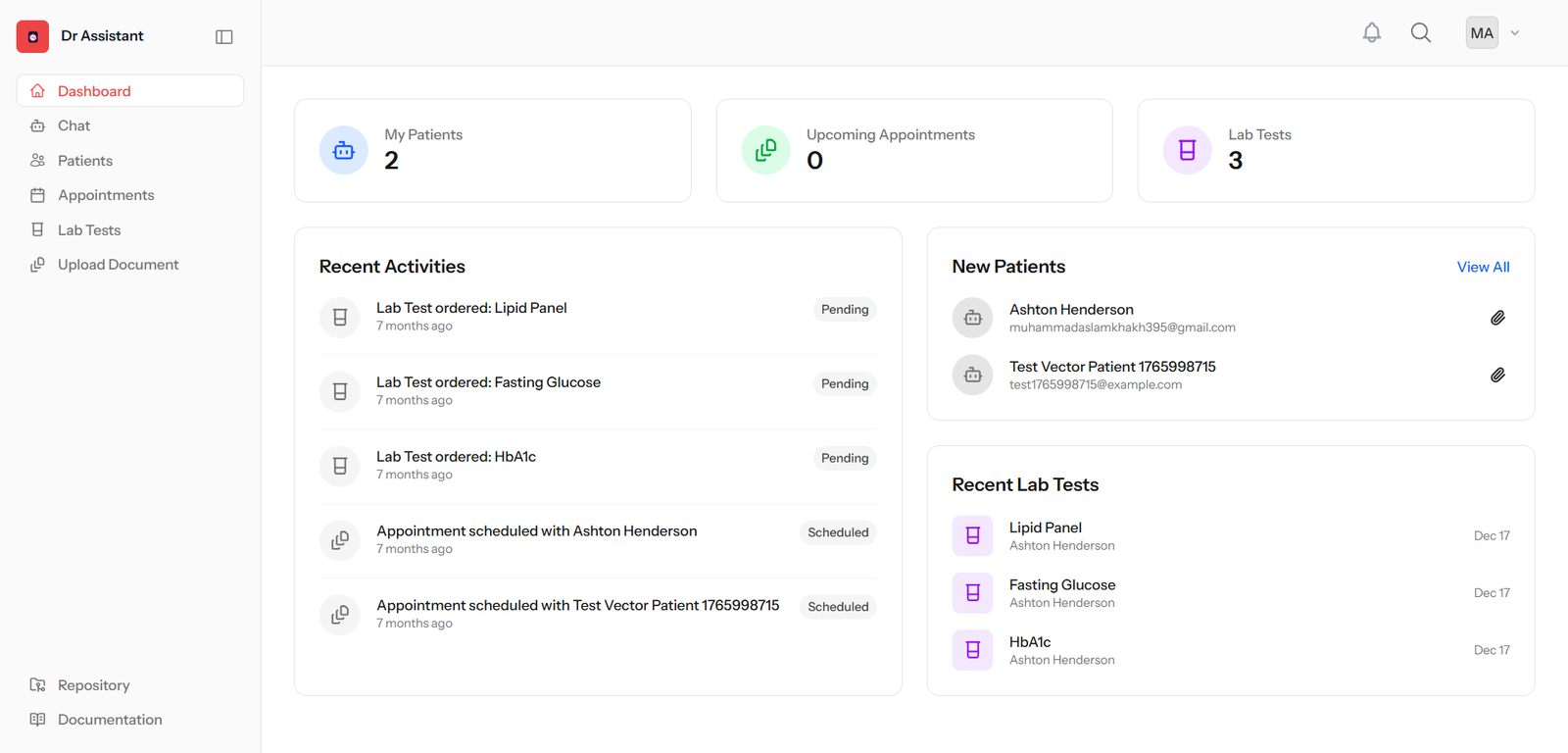
Dr Assistant is an AI-powered clinical management platform and conversational medical co-pilot designed to help healthcare providers manage patient information, analyze medical documents, and perform everyday clinical and administrative workflows from one unified system.
Instead of functioning as a simple AI chatbot, Dr Assistant combines patient management, Retrieval-Augmented Generation (RAG), AI agents, vector search, document processing, and tool execution to create an action-oriented healthcare assistant.
The Problem
Healthcare providers often work with patient information distributed across medical records, previous checkups, lab reports, PDF documents, appointments, and communication systems.
Finding relevant information during a consultation can require navigating multiple screens and reviewing lengthy documents.
Doctors and clinic staff also spend significant time performing repetitive administrative tasks such as scheduling appointments, ordering lab tests, reviewing reports, and preparing communications.
Generic AI assistants introduce another challenge: their responses may not be grounded in the actual patient's medical records.
The Solution
Dr Assistant brings patient information, clinical workflows, document intelligence, and conversational AI into one platform.
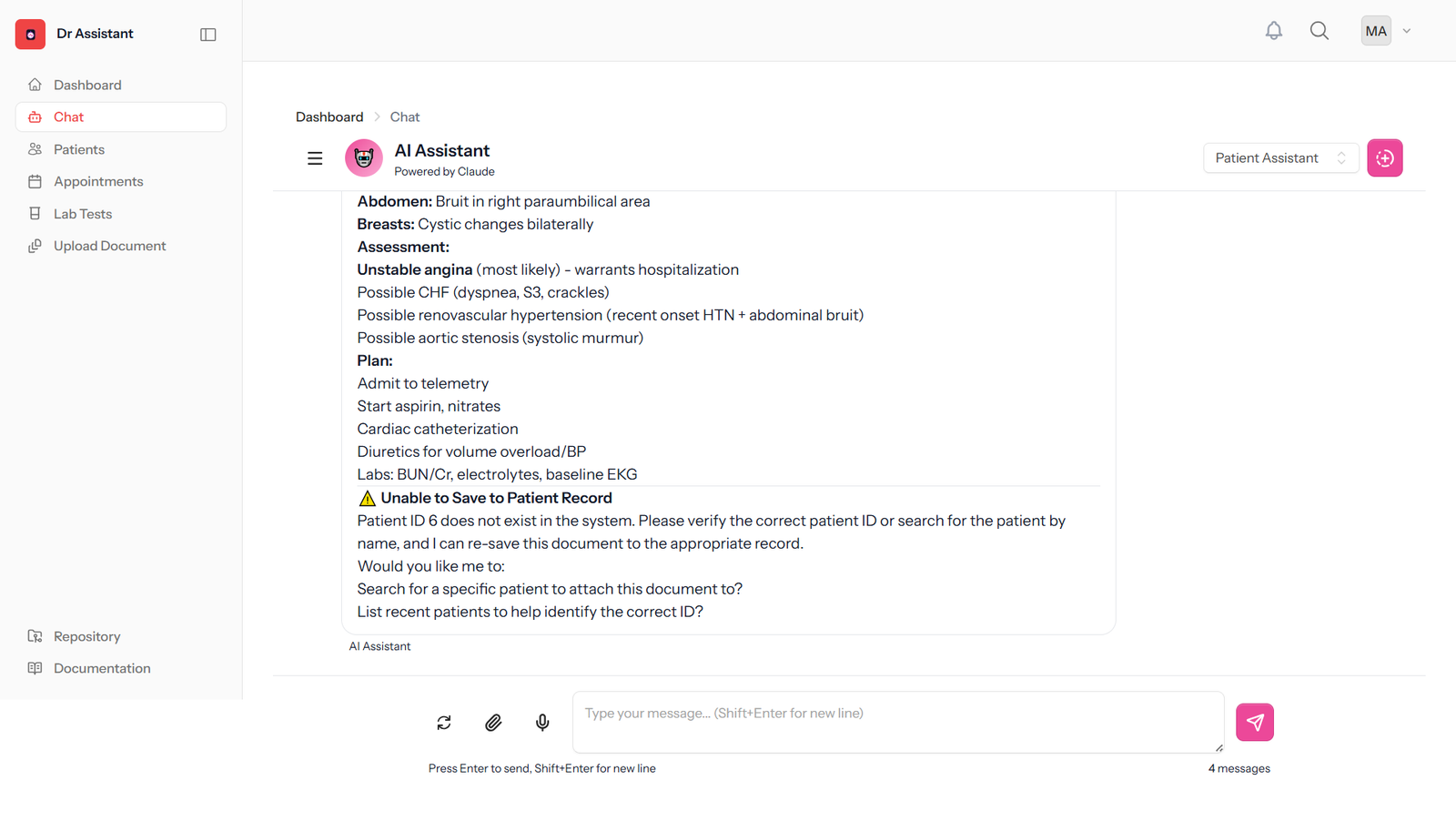
Healthcare providers can interact with the system using natural language to retrieve patient information and perform supported actions.
For example, a doctor can ask:
“What was this patient's last glucose reading?”
The AI can search the relevant patient history and provide a response based on available patient records rather than relying only on general model knowledge.
Key Features
• AI-powered clinical assistant
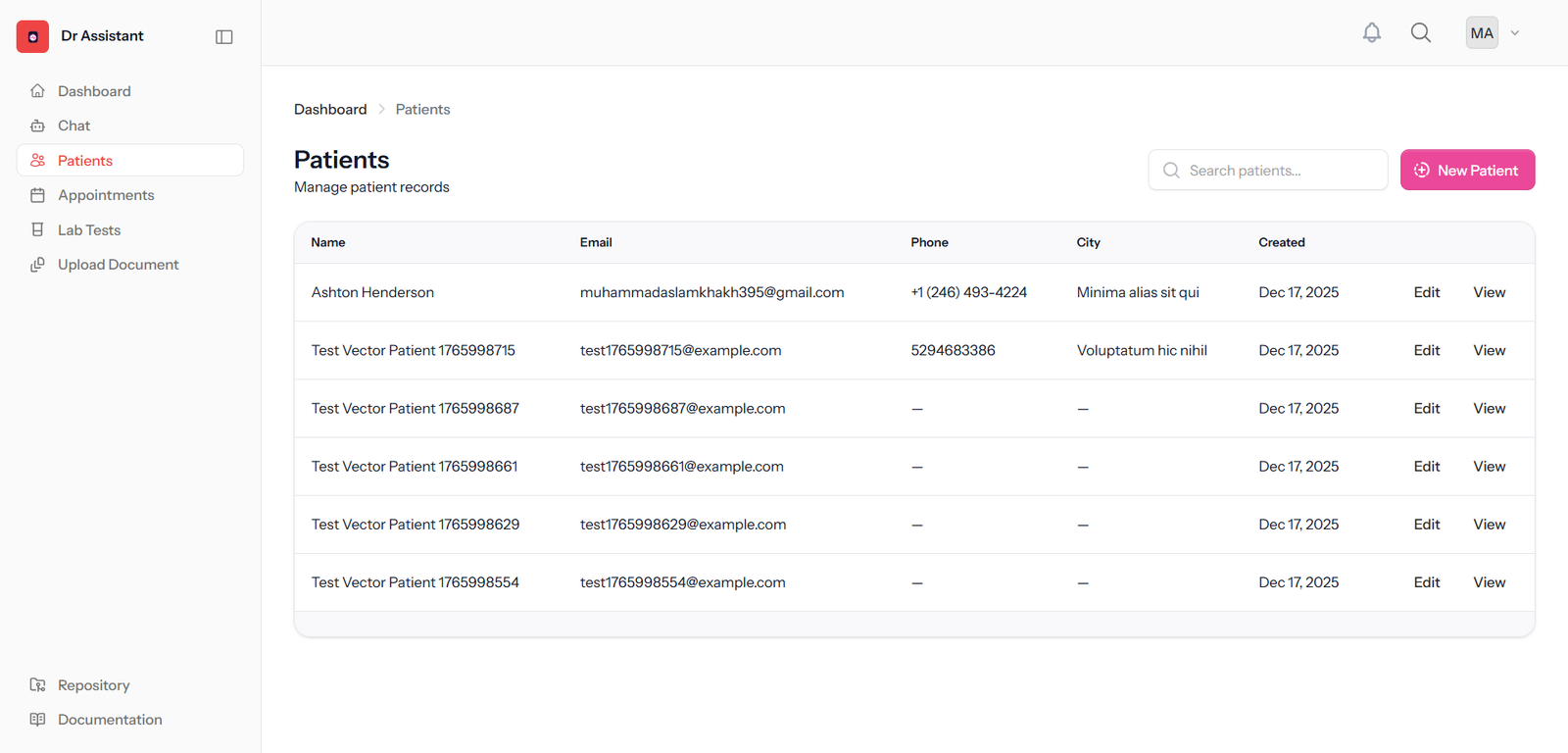
• Unified patient management
• Conversational patient-history search
• Retrieval-Augmented Generation (RAG)
• Patient-scoped vector search
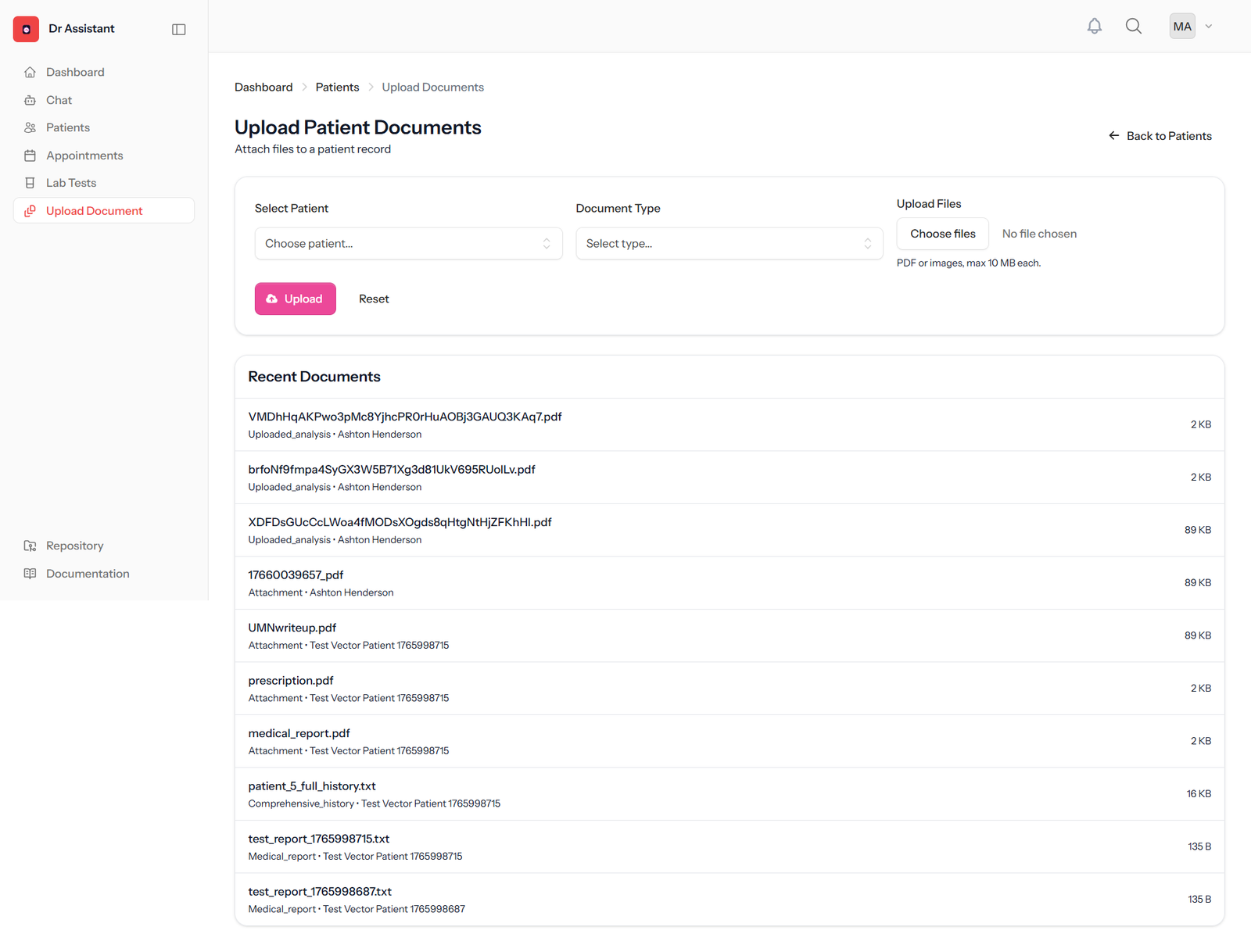
• Medical PDF and document processing
• AI-generated document summaries
• Source-backed information retrieval
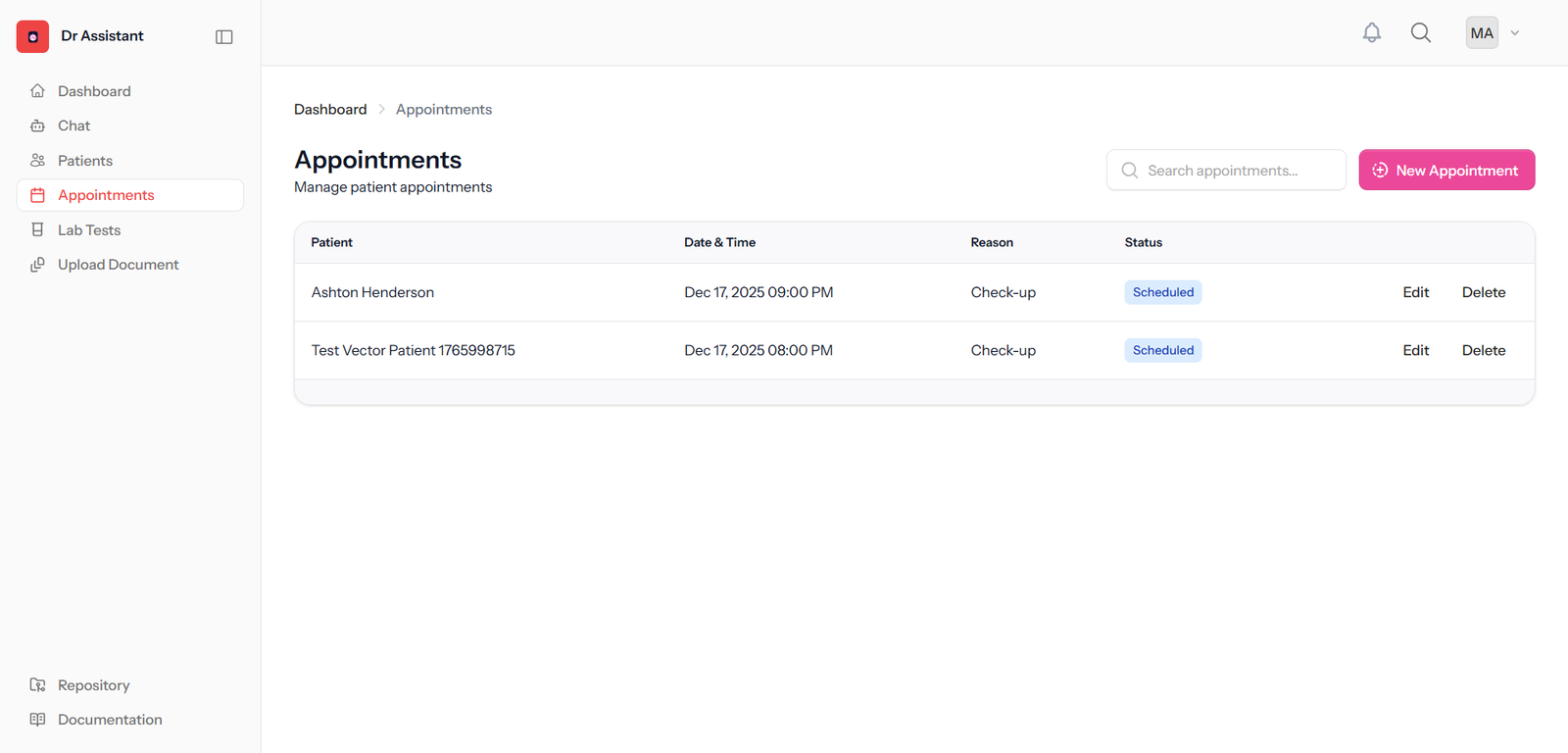
• Appointment scheduling
• Doctor schedule lookup
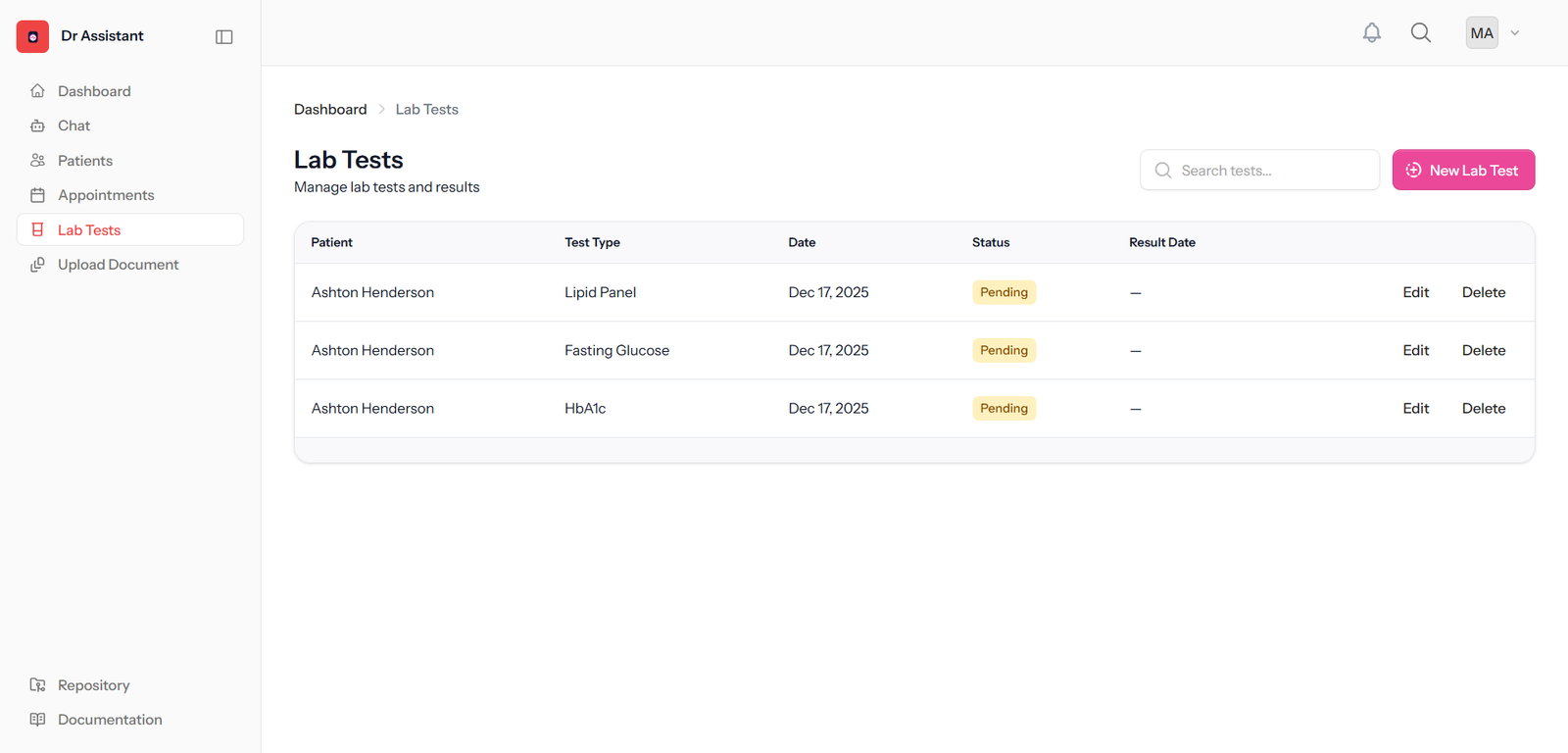
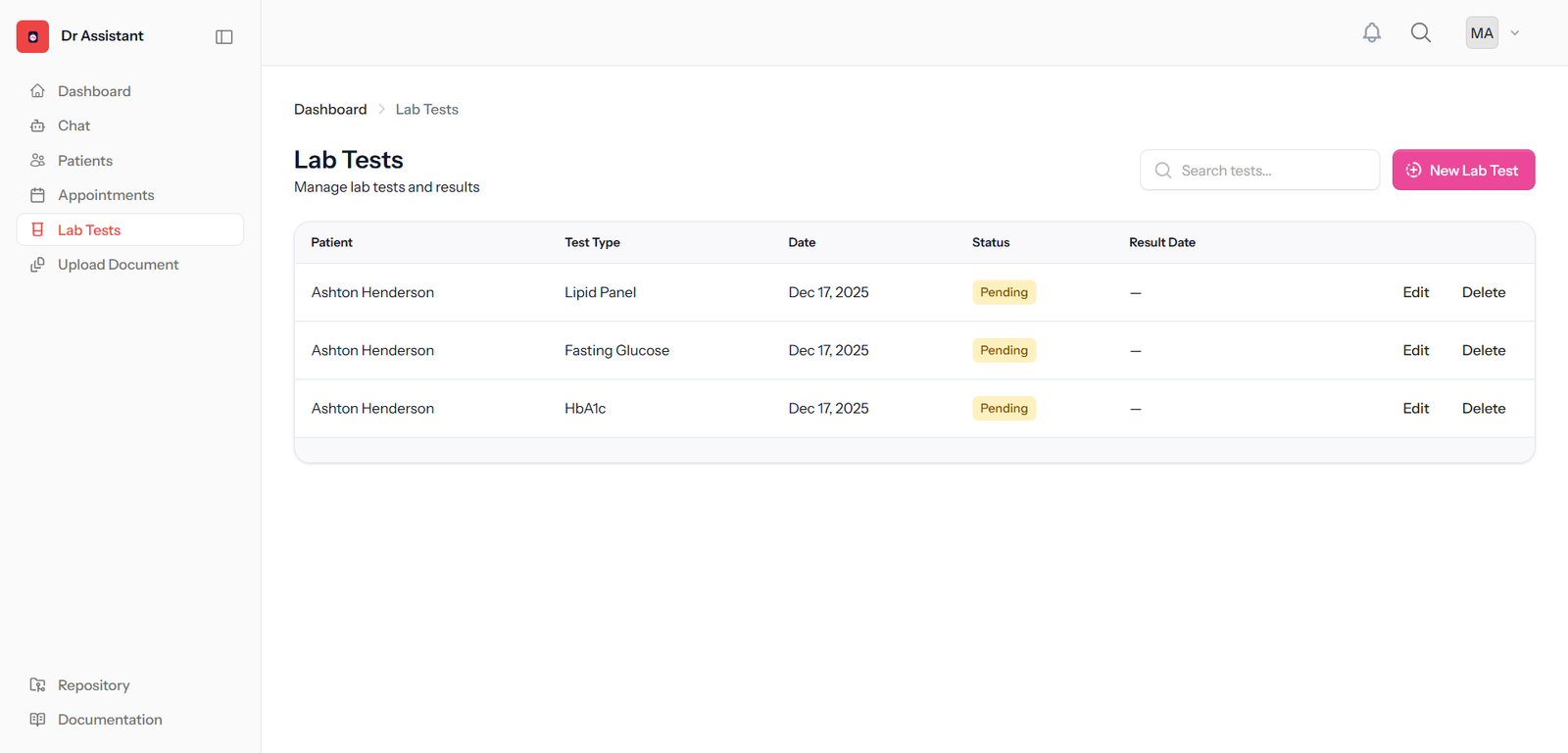
• Lab test ordering
• Lab report management
• Referral communication
• Email automation
• Background document processing
• Role and authentication management
AI & RAG Architecture
Dr Assistant uses Retrieval-Augmented Generation to connect AI conversations with patient-specific medical information.
Uploaded medical documents can be processed, divided into searchable chunks, converted into vector embeddings, and stored using PostgreSQL with pgvector.
When a healthcare provider asks a patient-specific question, relevant information can be retrieved from the patient's knowledge base and supplied as context to the AI.
This architecture helps keep responses grounded in available patient records and enables source-backed answers.
Action-Oriented AI
Dr Assistant goes beyond question-and-answer functionality.
The AI agent can use application tools to perform supported workflows such as:
• Book appointments
• Check doctor schedules
• Create lab test orders
• Retrieve patient information
• Search patient medical history
• Send lab result emails
• Prepare and send referral communications
This turns natural-language requests into real application workflows instead of simply generating text responses.
Technology Stack
Backend
Laravel 12 • PHP 8.2+ • Laravel Fortify • Laravel Queues
Laravel provides the core application architecture, authentication, database operations, background jobs, email services, and business logic.
Frontend
Livewire 3 • Flux UI • Volt • Tailwind CSS 4 • Vite 7
The interface uses Laravel's reactive frontend ecosystem to provide dynamic application experiences while maintaining a unified PHP application stack.
AI Layer
NeuronAI • Anthropic Claude • Google Gemini
NeuronAI provides AI agent orchestration and tool execution.
Claude is used for conversational and reasoning workflows, while Gemini embeddings support vector-based document retrieval.
Database & Vector Search
PostgreSQL • pgvector
Patient records, appointments, checkups, lab information, conversations, and other relational data are stored in PostgreSQL.
pgvector extends PostgreSQL with vector similarity search, allowing embeddings and traditional relational patient data to remain within the same database architecture.
Document Processing
PDF Parser • Vector Embeddings • Laravel Queue Workers
Uploaded medical documents are processed asynchronously.
The system extracts document content, prepares searchable chunks, generates embeddings, and adds the information to the appropriate patient knowledge base without blocking the main application.
Security & Authentication
Laravel Fortify provides authentication capabilities including secure sessions, password management, and two-factor authentication.
Patient-specific retrieval and application-level authorization help keep medical context isolated to the appropriate workflows.
Real-World Impact
Doctors & Private Clinics
Doctors can access patient history and perform common workflows from one interface, reducing the amount of time spent switching between different parts of the system.
Specialty Clinics
Clinics handling long-term patient histories and recurring laboratory monitoring can use AI-assisted retrieval to quickly understand historical information and trends.
Diagnostic & Pathology Workflows
Medical reports can be processed into searchable knowledge, helping providers retrieve information from previously uploaded diagnostic documents.
Telemedicine
Remote healthcare providers can access summarized patient context and manage supported clinical workflows from a centralized platform.
Key Technical Advantage
The major strength of Dr Assistant is the combination of conversational AI with real application tools and patient-scoped RAG.
Rather than building a standalone medical chatbot, the system connects AI reasoning with patient records, vector search, document processing, appointments, laboratory workflows, and communication tools.
The Result
Dr Assistant demonstrates how AI can be integrated into a real healthcare management workflow.
It combines Laravel application engineering, AI agents, RAG, vector databases, document processing, background jobs, and natural-language tool execution into a unified clinical management platform.
The result is an intelligent medical co-pilot designed to help healthcare providers access relevant patient information faster and reduce repetitive administrative work.
Dr Assistant is an AI-powered clinical management platform and conversational medical co-pilot designed to help healthcare providers manage patient information, analyze medical documents, and perform everyday clinical and administrative workflows from one unified system.
Instead of functioning as a simple AI chatbot, Dr Assistant combines patient management, Retrieval-Augmented Generation (RAG), AI agents, vector search, document processing, and tool execution to create an action-oriented healthcare assistant.
The Problem
Healthcare providers often work with patient information distributed across medical records, previous checkups, lab reports, PDF documents, appointments, and communication systems.
Finding relevant information during a consultation can require navigating multiple screens and reviewing lengthy documents.
Doctors and clinic staff also spend significant time performing repetitive administrative tasks such as scheduling appointments, ordering lab tests, reviewing reports, and preparing communications.
Generic AI assistants introduce another challenge: their responses may not be grounded in the actual patient's medical records.
The Solution
Dr Assistant brings patient information, clinical workflows, document intelligence, and conversational AI into one platform.
Healthcare providers can interact with the system using natural language to retrieve patient information and perform supported actions.
For example, a doctor can ask:
“What was this patient's last glucose reading?”
The AI can search the relevant patient history and provide a response based on available patient records rather than relying only on general model knowledge.
Key Features
• AI-powered clinical assistant
• Unified patient management
• Conversational patient-history search
• Retrieval-Augmented Generation (RAG)
• Patient-scoped vector search
• Medical PDF and document processing
• AI-generated document summaries
• Source-backed information retrieval
• Appointment scheduling
• Doctor schedule lookup
• Lab test ordering
• Lab report management
• Referral communication
• Email automation
• Background document processing
• Role and authentication management
AI & RAG Architecture
Dr Assistant uses Retrieval-Augmented Generation to connect AI conversations with patient-specific medical information.
Uploaded medical documents can be processed, divided into searchable chunks, converted into vector embeddings, and stored using PostgreSQL with pgvector.
When a healthcare provider asks a patient-specific question, relevant information can be retrieved from the patient's knowledge base and supplied as context to the AI.
This architecture helps keep responses grounded in available patient records and enables source-backed answers.
Action-Oriented AI
Dr Assistant goes beyond question-and-answer functionality.
The AI agent can use application tools to perform supported workflows such as:
• Book appointments
• Check doctor schedules
• Create lab test orders
• Retrieve patient information
• Search patient medical history
• Send lab result emails
• Prepare and send referral communications
This turns natural-language requests into real application workflows instead of simply generating text responses.
Technology Stack
Backend
Laravel 12 • PHP 8.2+ • Laravel Fortify • Laravel Queues
Laravel provides the core application architecture, authentication, database operations, background jobs, email services, and business logic.
Frontend
Livewire 3 • Flux UI • Volt • Tailwind CSS 4 • Vite 7
The interface uses Laravel's reactive frontend ecosystem to provide dynamic application experiences while maintaining a unified PHP application stack.
AI Layer
NeuronAI • Anthropic Claude • Google Gemini
NeuronAI provides AI agent orchestration and tool execution.
Claude is used for conversational and reasoning workflows, while Gemini embeddings support vector-based document retrieval.
Database & Vector Search
PostgreSQL • pgvector
Patient records, appointments, checkups, lab information, conversations, and other relational data are stored in PostgreSQL.
pgvector extends PostgreSQL with vector similarity search, allowing embeddings and traditional relational patient data to remain within the same database architecture.
Document Processing
PDF Parser • Vector Embeddings • Laravel Queue Workers
Uploaded medical documents are processed asynchronously.
The system extracts document content, prepares searchable chunks, generates embeddings, and adds the information to the appropriate patient knowledge base without blocking the main application.
Security & Authentication
Laravel Fortify provides authentication capabilities including secure sessions, password management, and two-factor authentication.
Patient-specific retrieval and application-level authorization help keep medical context isolated to the appropriate workflows.
Real-World Impact
Doctors & Private Clinics
Doctors can access patient history and perform common workflows from one interface, reducing the amount of time spent switching between different parts of the system.
Specialty Clinics
Clinics handling long-term patient histories and recurring laboratory monitoring can use AI-assisted retrieval to quickly understand historical information and trends.
Diagnostic & Pathology Workflows
Medical reports can be processed into searchable knowledge, helping providers retrieve information from previously uploaded diagnostic documents.
Telemedicine
Remote healthcare providers can access summarized patient context and manage supported clinical workflows from a centralized platform.
Key Technical Advantage
The major strength of Dr Assistant is the combination of conversational AI with real application tools and patient-scoped RAG.
Rather than building a standalone medical chatbot, the system connects AI reasoning with patient records, vector search, document processing, appointments, laboratory workflows, and communication tools.
The Result
Dr Assistant demonstrates how AI can be integrated into a real healthcare management workflow.
It combines Laravel application engineering, AI agents, RAG, vector databases, document processing, background jobs, and natural-language tool execution into a unified clinical management platform.
The result is an intelligent medical co-pilot designed to help healthcare providers access relevant patient information faster and reduce repetitive administrative work.
Project Gallery
Visual Showcase

Interested in Similar Work?
Let's discuss how we can create something amazing for your business with the same level of engineering excellence.